
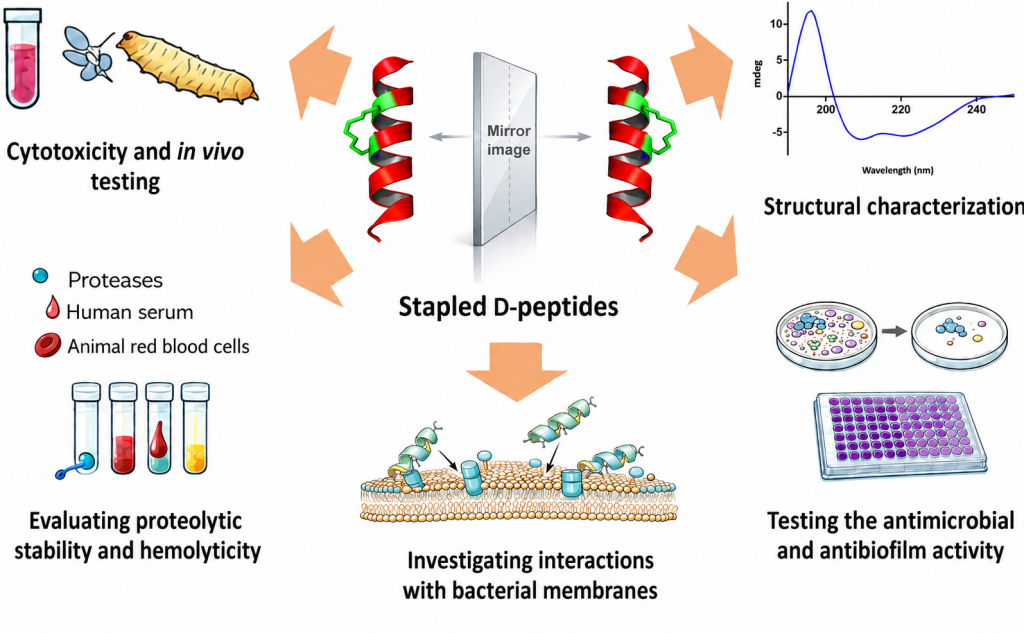
Membrane-active stapled D-peptides: a novel strategy to combat multidrug-resistant pathogens and biofilms
Responding to the urgent need for new antimicrobial strategies effective against multidrug-resistant (MDR) pathogens, antimicrobial peptides (AMPs) have attracted considerable attention as alternatives to conventional antibiotics. However, two critical limitations hinder the clinical translation of linear AMPs: i) susceptibility to enzymatic degradation, resulting in short half-lives in biological fluids, and ii) the relatively high concentrations required for bacterial killing, which can cause unacceptable toxicity to human cells.
This project proposes a dual stabilization strategy – combining complete D-amino acid replacement with hydrocarbon stapling – to convert selected parent AMPs into proteolytically resistant, structurally reinforced D-peptide analogues with enhanced antimicrobial performance and preserved biocompatibility. Replacing the entire peptide backbone with D-amino acids renders the peptide unrecognizable to host proteases. At the same time, an intramolecular hydrocarbon staple locks the chain into a well-defined α-helical conformation, maximizing the amphipathic architecture critical for interaction with bacterial membranes.
Adapting the sequences of several antimicrobial peptides will allow the development of novel hydrocarbon-stapled D-peptides of improved structural and proteolytic stability, antimicrobial and antibiofilm efficacy, and low toxicity toward human cells and animals (Galleria mellonella larvae).
Further information can be found HERE
Principal Investigator: dr Mateusz Wdowiak
Project period: 2026 – 2029
Funding: Sonatina 10, National Science Centre
