
Investigating the interactions between Antibiofilm and Antimicrobial Peptides against Acinetobacter baumannii biofilms
The increasing antimicrobial resistance of ESKAPE pathogens, including Acinetobacter baumannii, represents a major global health challenge. Biofilm formation further complicates treatment, as these structured microbial communities exhibit enhanced tolerance to antibiotics and facilitate the spread of resistance. While antimicrobial peptides (AMPs) and antibiotics primarily target planktonic cells, antibiofilm peptides (ABPs) have emerged as promising agents capable of interfering with biofilm formation and maintenance. However, ABPs alone may release viable cells, potentially promoting recolonization, and systematic studies of ABP–AMP combinations remain limited.
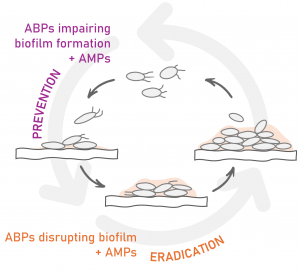
This project aims to evaluate whether combining ABPs with AMPs enhances activity against A. baumannii biofilms. Two well-characterized ABPs, peptides 1018 and 1037, will be synthesized and tested in combination with four AMPs, including two phage endolysin-derived peptides and their hydrocarbon-stapled analogs. Combinations will be assessed for their ability to prevent biofilm formation and disrupt established biofilms using a crystal violet assay. Synergistic interactions will be quantified using the fractional inhibitory concentration index. This study will offer insight into the potential of ABP–AMP combinations as an effective approach for combating biofilm-associated antimicrobial resistance.
Principal Investigator: dr inż. Emil Stefańczyk
Project period: 2025 – 2026
Funding: Miniatura 9, National Science Centre
