
The use of siderophore-peptide nucleic acid conjugates for selective elimination of Yersinia enterocolitica
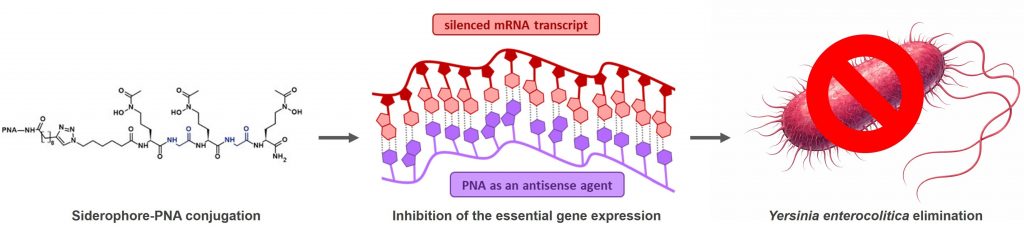
Iron is a critical microelement for bacterial growth and pathogenicity, and it is the most abundant cofactor of many enzymes. However, iron is mostly present in the form of ferric (Fe3+) salts, which are insoluble in water and, therefore, biologically unavailable. To overcome this obstacle, bacteria produce siderophores – iron-chelating molecules that are secreted into the environment to scavenge ferric iron and transport it into the bacterial cell. Most known bacteria produce their siderophores but can also take up external siderophores (xenosiderophores), which makes the bacterial iron-uptake system a potential route to deliver antibacterial agents inside the cells. Since many commonly used antibiotics have become ineffective against clinically relevant strains due to the spread of drug resistance, both delivery routes and new antibacterial agents need to be explored. Given this challenge, eliminating bacteria by the selective inhibition of gene expression using anti-sense therapy is of great interest. Among the anti-sense approaches, the use of peptide nucleic acids (PNAs) – synthetic polymers, similar to natural nucleic acids (DNA or RNA), that consist of nucleobases connected by the N-(2-aminoethyl)-glycine backbone, shows promise. PNAs demonstrate advantages over DNA or RNA, including improved stability and affinity for target gene sequences. Siderophore-PNA conjugates have been successfully applied as anti-sense molecules, but only in model bacteria, such as Escherichia coli.
This project aims to explore the possibility of using gene-silencing siderophore-PNA conjugates in Yersinia enterocolitica – a foodborne pathogen causing severe gastrointestinal infections. Two major goals of the project are i) testing the siderophore-PNA conjugates designed to work in E. coli on other bacterial species, and ii) developing new PNA sequences targeting the essential genes of Y. enterocolitica.
Tsylents U, Burmistrz M, Wojciechowska M, Stępień J, Maj P and Trylska J (2024) Iron uptake pathway of Escherichia coli as an entry route for peptide nucleic acids conjugated with a siderophore mimic. Front. Microbiol. 15:1331021. doi: 10.3389/fmicb.2024.1331021
Principal Investigator: dr Mateusz Wdowiak
Project period: 2025 – 2026
Funding: Miniatura 9, National Science Centre
